We have been blessed with some absolutely amazing markets lately.
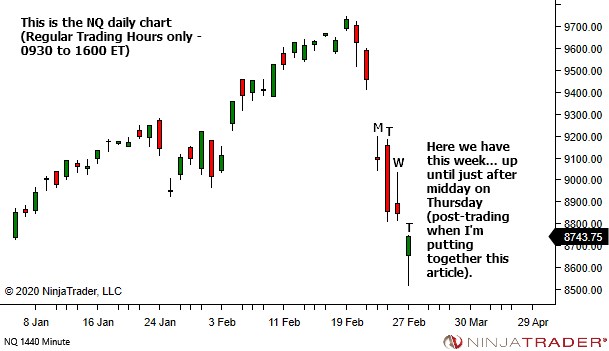


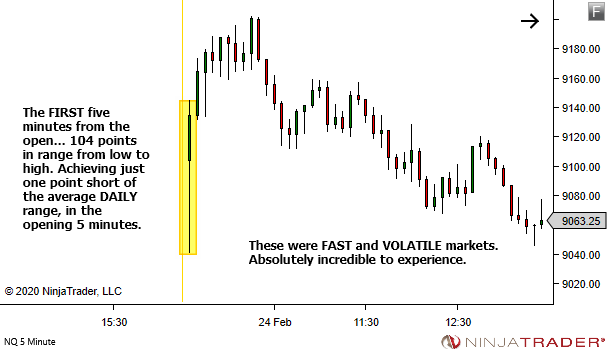
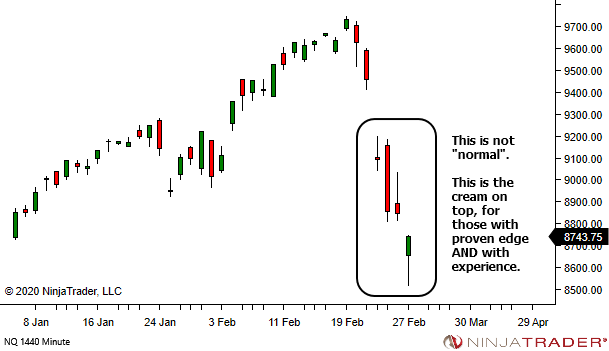
Incredible daily ranges. Incredible opportunity.
And incredible risk, if not played wisely.
So while it’s tempting to use today’s article as an ego-boosting review of a couple of winning trades, that’s not really what motivates me with my YTC writing.
I’m more concerned about your journey. I want you to succeed LONG-TERM. And I’m worried that right now there is more potential for damage than there is good.
So today – something a little different and perhaps unexpected.
For the developing traders… the ones who are still working towards either finding their edge or consistently applying their edge… I’m going to try to talk you out of trading these markets.
This week’s action is already gone. But I have a suspicion that there is more volatility to come. And even if I’m wrong and it’s all over for now, there will again be times in the future when markets crash and this article can make a timely comeback.
Here is what I’m thinking:

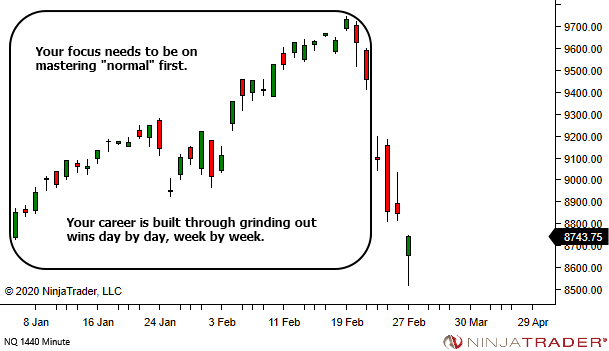
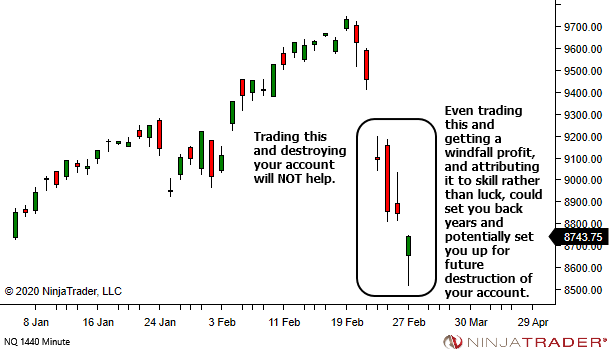
I’d be impressed if I received this email or private message: “Lance, I’ve worked my backside off for the last year and managed to grind out wins every week for the last quarter. But this last week – I’ve stood aside. I’m not ready for that pace yet.â€
This would not impress me at all: “Lance, these markets are frickin’ awesome. My trading has been crap for months, but I just smashed it today. $5000 profits. I think I’ve finally turned a corner and have got this game worked out.â€
I’d back the first trader to succeed long term, over the second.
Repeating…
Trading is never compulsory. At any time if you feel the conditions are beyond your current levels of skill and experience, then the RIGHT decision is to stand aside.
However this does not mean you close up shop for the day. There is still valuable work to be done in building experience and expanding your skill levels, so that when these conditions return again in the future you will be ready and able to thrive in the opportunity they present.
So here’s the plan:
- Put aside any feelings of FOMO. One day these will be your markets, but not today. Let it go.
- And use these sessions SOLELY as learning opportunities.
There are many options for learning:
- Do not trade at all. Simply follow the market attempting to stay in sync with the price flow. Build confidence in your ability to not only read the current trend but to also keep your mind ahead of the market, through projecting the current trend forward and identifying the most probable future path.
- Or SIM trade, if you feel you’ve already advanced beyond that first idea. Build skill in trading at these new levels of pace and volatility, without risking actual funds.
- Or maybe a combination of the two. Watch price live, but record data so that you can trade key sequences through post-session replay.
I’m sure you can come up with numerous other options.
The key point is…
Trading is optional. Learning is not.
Maybe I’m wrong. But I don’t think so. You know your own level of skill and experience and are big enough and old enough to make your own decisions. Perhaps you think you’ll be fine in these markets. All I ask is you consider the risk. Play these markets wrong, and let them put you into tilt where you start compounding bad decision after bad decision, and these sessions can destroy you.
We often know when we’re about to have one of these high volatility days. The gaps overnight and the news leading into the session made it obvious that Monday and Tuesday were going to be highly emotional sessions. There is little to lose by choosing to stand aside. Choose to focus your live trading on more “normal†sessions. And use these higher volatility sessions as a learning opportunity.
It’s your choice though.
So having said that, let me add a few thoughts for those who do trade these sessions:
- Structure your trading so that individual trade risk and session risk still fit within their normal parameters. This will typically require reducing position sizes and widening stops, in order to cater for the greatly increased volatility. Some may also prefer reductions in chart timeframes, noting that this can create its own challenges through speeding up the whole process.
- Don’t get stuck in “prediction modeâ€. The market doesn’t care where you think it should be going. Even in a crash, the market can have massive rips higher. Ensure that your game plan is visualised pre-session and you have clear guidelines for how to recognise the ACTUAL direction of the market and how to align with that direction, despite what you feel it should be doing.
- Recognise that the simpler opportunity is almost always going to be WITH the market direction, not against. If you’re a counter-trend trader, consider countering the pullbacks for continuation in the larger session-bias direction.
- Before placing any trade, KNOW WHERE YOU ARE WRONG. And do not hold beyond that point. Standard practice really, but especially important in these environments.
- And finally, most importantly of all, never forget that your number one aim each and every day is to SURVIVE TO TRADE ANOTHER DAY.
Take care out there,
Lance Beggs
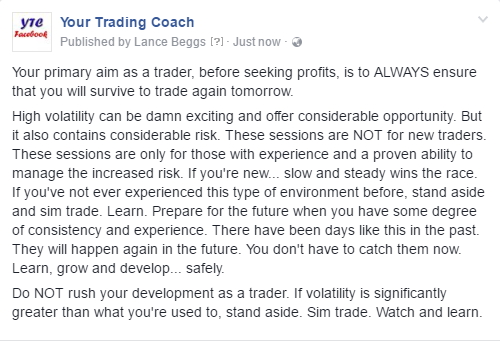
PS. At the risk of repeating everything above, let me share the post that was sent out Monday morning prior to the open. (Sign up for YTC social media here)